I Am America: The Rebel in a Calico Wrapper
At 73 years old, society expected Mary Nolan to be a quiet observer of history. Instead, she chose to become its most defiant participant. A sophisticated educator and an architect of Southern literacy, Nolan didn't just join a movement; she brought the sharpened grit of the Irish diaspora to the front gates of the White House. This month, as we explore the stories of Unsung Irish Roses in America, we look at the woman who proved that some of the most radical acts of rebellion are carried out by those we are taught to overlook.
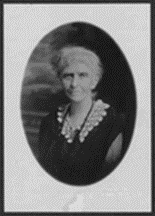
From Martinsburg to the Classroom: The Early Years
Mary A. Nolan was born in 1842 in Martinsburg, Virginia (now West Virginia). Growing up in a mid-19th-century America defined by rigid social hierarchies and the shadow of the Great Hunger in Ireland, Mary sought a path that favored the mind over domestic invisibility. She was educated at the Mont de Chantal Visitation Academy, a prestigious convent school in Wheeling known for its rigorous academic and musical training.
This foundation shaped her into a woman of formidable intellect. Long before she was a political activist, she was a professional educator. She spent her early adulthood as a teacher, moving through the South during a period of immense upheaval.
In her personal life, Mary’s story took an unconventional turn for the era. She married late—around the age of 45—to a man named John Nolan. The couple moved to Jacksonville, Florida, where Mary’s life took on a dual character: she was a respected figure in Southern society, known for her leadership in cultural and intellectual circles, while simultaneously harboring the radical spirit that would define her later years. After John’s death, Mary remained in Jacksonville, using her independence to further her work in the library movement and, eventually, the suffrage struggle.
The Intellectual Architect: Power Through Literacy
Mary’s first major rebellion was against ignorance. She became a central figure in the Southern library movement, a grassroots effort to bring literacy and resources to a region where public education was often a luxury. Mary didn't just advocate for libraries; she built them from the ground up.
Her most significant achievement was in Laurens, South Carolina, where she was instrumental in establishing the city’s first permanent library. She understood that knowledge was a form of power, and she believed that access to books was a fundamental right. For decades, she worked as a library pioneer, proving her leadership long before she ever set foot on a picket line.
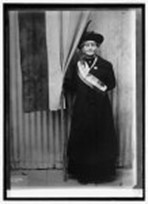
The Rebellion of the "Oldest Picket"
In 1917, Mary traveled from her home in Jacksonville to the front lines of Washington, D.C., to join the National Woman’s Party (NWP).Despite a handicap in her foot that made standing for hours a physical ordeal, she became one of the "Silent Sentinels." When she was arrested on November 10, 1917, for "obstructing traffic," the judge—confronted by her age and frail appearance—urged her to pay a small fine and go home.
Mary’s response was a sharp reminder of her Irish American defiance:
"Your honor, I have a nephew fighting for democracy in France. He is offering his life for his country. I should be ashamed if I did not join these brave women in their fight for democracy in America. I should be proud of the honor to die in prison for the liberty of American women."
The Night of Terror: Survival and Subversion
Mary was sentenced to six days and sent to the notorious Occoquan Workhouse. On the night of November 14, 1917—remembered as the "Night of Terror"—the state attempted to break the women through sheer brutality.
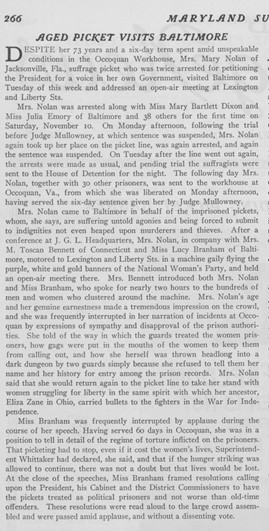
Mary recalled being "jerked down the steps and away into the dark" by two guards. Despite her pleas that she would go willingly, she was handled with such force that she was thrown into a punishment cell, striking an iron bed and losing consciousness. From her cell, she watched as fellow activist Dorothy Day was slammed twice over the arm of an iron bench.
However, Mary’s true act of rebellion came after her release. Using her skills as an educator and writer, she penned "That Night of Terror" for The Suffragist. It was the first full account of the guards' violence, and her words were the catalyst that eventually forced the government to fire the workhouse superintendent and release the remaining prisoners.
The Prison Special: "Democracy Limited"
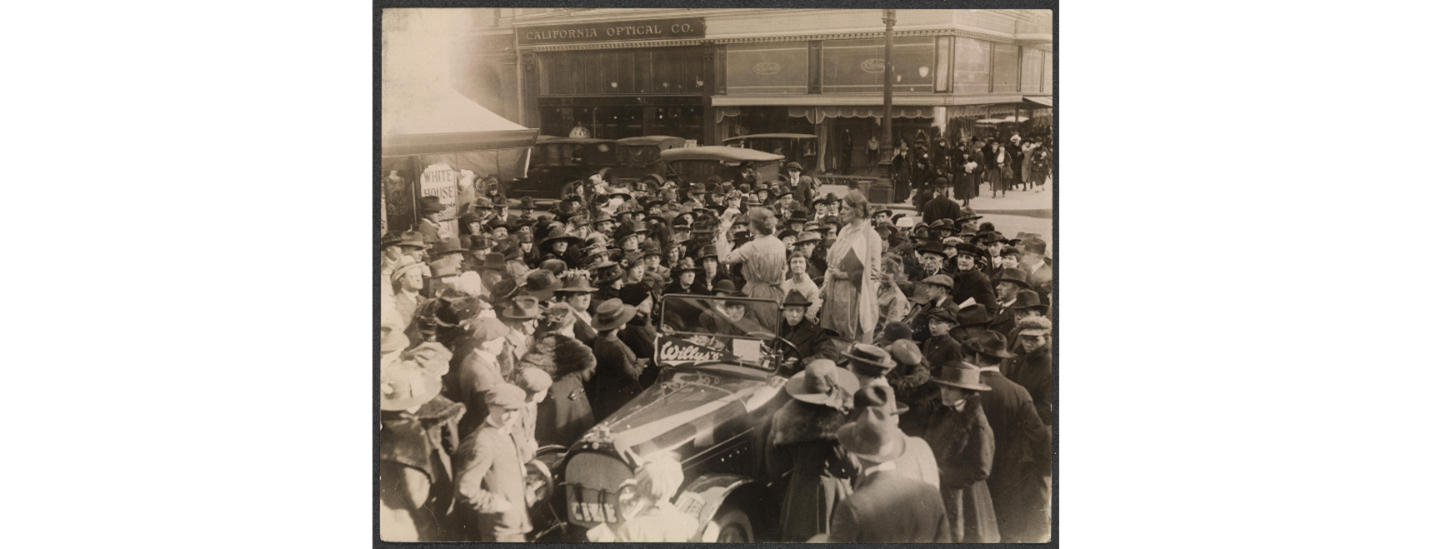
Mary’s defiance didn't end at the prison gates. In 1919, at the age of 75, she joined the "Prison Special" tour. Twenty-six suffragists boarded a train car they ironically named "Democracy Limited," traveling to 16 cities to expose the government’s treatment of women.
In a daring piece of political theater, the women appeared in public dressed in replicas of their prison uniforms—the heavy, shapeless "calico wrappers" and muslin underclothing they had been forced to wear at Occoquan. Mary was the star of the tour; crowds flocked to see the "oldest picket" speak from the train platform. By wearing the "cloth of guilt" in public, she turned the government's attempt to shame her into a badge of courage.
Reclaiming the Landmark
Between 1917 and 1919, Mary was arrested ten times. She participated in the "Watchfire" demonstrations, burning President Wilson’s speeches to show that words without action were hollow. She lived to see the 19th Amendment ratified, casting her vote in Florida before passing away in 1925.
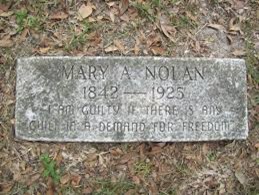
For over 50 years, Mary lay in an unmarked grave in Jacksonville's Evergreen Cemetery. While the official history of the movement often focused on younger, more "palatable" faces, Mary’s radical intent and her eyewitness testimony of the Night of Terror became a footnote. It wasn't until 1982 that she was finally given a headstone, engraved with the words that defined her final years: "I am guilty if there is any guilt in a demand for freedom."
Mary Nolan’s life did not save industry or conquer nations, but it did something equally profound: it forced a dialogue on what it means to be a citizen. She brought the tenacity of the Irish immigrant experience to the pavement of Pennsylvania Avenue, proving that a demand for freedom is never a crime, regardless of age. We share her story not as a new discovery, but as a necessary acknowledgment of the Irish American grit that helped shape the frontlines of our democracy. Mary Nolan did not just witness history; she stood at the gate and forced it to open, and this month, we honor the rebel who refused to be silent.
Unless otherwise noted, historical images are courtesy of the Library of Congress, Records of the National Woman's Party; headstone imagery via Find a Grave.